Should a small business choose a website or an Instagram business page?
They do different jobs. Instagram is best for being discovered, showing your work visually and staying in touch with followers. A website is best for being found on Google, building trust, explaining services and prices in detail, and turning visitors into enquiries on a platform you own. Most small businesses should start Instagram early and add a simple website as soon as customers start searching for them, comparing options or asking for prices — then use each channel to send people to the other.
Most small businesses in India go online the same way: someone creates an Instagram account, posts a few photos of products or completed work, and enquiries start arriving in DMs. It is free, quick and familiar. A few months later the same owner starts wondering — do we need a proper website too, or is Instagram enough?
There is no single right answer, because the two platforms do different jobs. Instagram helps people discover you while they scroll. A website helps people find and trust you when they are actively looking. This guide compares both honestly so you can decide what your business needs now, and what it will need as it grows.
What is an Instagram business page?
An Instagram professional (business) account is a free profile with extra tools for businesses. It gives you:
- A business profile with category, contact buttons (call, email, WhatsApp) and links in your bio.
- Posts and Reels to show products, before-and-after work, behind-the-scenes and short videos. Reels can reach people who do not follow you yet.
- Stories for daily updates, offers and polls that disappear after 24 hours (or stay as Highlights).
- Direct messages where most customer conversations happen.
- Instagram advertising through Meta Ads Manager, to reach people by location, age and interests.
- Insights showing reach, engagement and follower activity.
Advantages
- Free to start and easy to manage from a phone.
- Excellent for visual businesses — food, fashion, salons, interiors, events, real estate.
- Built-in discovery through Reels, hashtags, location tags and shares.
- Direct, informal conversation with customers.
Limitations
- You don't own the platform. Reach depends on the algorithm, and accounts can be restricted or hacked.
- Little Google visibility for searches like "interior designer in Kukatpally" — those results are usually led by Google Business Profiles and websites.
- Limited space to explain. Detailed service descriptions, price lists, policies and FAQs don't fit well in captions.
- Enquiries scatter across DMs and are easy to miss or forget to follow up.
What is a business website?
A business website is your own online address — for example yourbusiness.in — that you control. A typical small business website includes:
- Homepage that says clearly what you do, where, and for whom.
- About page with your story, team and experience.
- Service or product pages with details, photos and prices.
- Contact page with phone, address, map and opening hours.
- Enquiry forms that send leads straight to your email or WhatsApp.
- WhatsApp integration so visitors can message you in one tap.
- Search engine visibility — pages Google can index and show for relevant searches.
- Website analytics (Google Analytics and Search Console) showing where visitors come from and what they do.
The key difference is ownership. Your domain, content and customer enquiries stay yours, whatever happens to any social platform. A website also works as the "home base" that every other channel — Instagram, Google Maps, ads, WhatsApp, visiting cards — can point to.
Website vs Instagram: detailed comparison
| Factor | Instagram business page | Business website |
|---|---|---|
| Ownership & control | Platform-owned; rules, features and reach can change | You own the domain and content |
| Branding | Same layout as every other account | Fully your own design, colours and structure |
| Google search visibility | Limited for service and location searches | Can rank for your services, area and brand name |
| Customer enquiries | DMs and comments, easy to lose track of | Forms, WhatsApp and call buttons, tracked as leads |
| Product / service presentation | Strong visuals, short captions | Detailed pages, prices, FAQs, policies |
| Customer communication | Fast, informal, two-way | Structured; best paired with WhatsApp |
| Analytics | Reach and engagement insights | Traffic sources, search terms, enquiries and sales |
| Advertising | Meta ads to targeted audiences | Landing pages for Google Ads and Meta ads; better conversion tracking |
| Long-term presence | Depends on staying active and on the platform | Keeps working 24/7, even when you post less |
| Scalability | Limited to platform features | Add booking, online payments, a store or a blog |
Neither column "wins" outright. Instagram is stronger for attention and visual storytelling; a website is stronger for search, trust and converting interest into enquiries.
Cost comparison in India
The real comparison is not "free vs paid". Both cost money once you take them seriously — just in different ways.
Instagram costs
| Item | Type | Notes |
|---|---|---|
| Account creation | Free | Professional account has no fee |
| Content creation | Recurring (time or money) | Regular posts, Reels and Stories take hours every week |
| Professional photography / video | One-time or recurring | Optional, but improves results for visual businesses |
| Advertising | Recurring | You set the budget; GST is added on ad spend in India |
| Social media management | Recurring | If you hire someone to plan and post content |
Website costs
| Item | Type | Notes |
|---|---|---|
| Domain name | Recurring (yearly) | Registered in your name |
| Hosting | Recurring (yearly) | Domain and hosting together are usually about ₹4,000–₹12,000 per year |
| Website development | One-time | At CodeServe: Starter website ₹9,999, Business website ₹19,999, e-commerce store ₹34,999 |
| Maintenance | Recurring (optional) | Updates, backups and security; CodeServe care plans start at ₹1,999/month |
| Integrations | One-time (optional) | WhatsApp automation, booking, payment gateway, CRM |
A simple website is mostly a one-time build plus a small yearly cost, while serious Instagram marketing is mostly an ongoing cost of time, content and ads. For a fuller breakdown, read how much a website costs in Hyderabad.
Can Instagram alone grow a business?
Yes — some businesses grow a long way on Instagram alone, especially home bakers, boutiques, artists and creators with strong visual content and a loyal local following. But it helps to understand the trade-offs:
- Organic discovery is not guaranteed. Reels can reach new people, but reach rises and falls with the algorithm and how often you post.
- Followers are not customers. A large follower count looks good, but what matters is how many people enquire and buy.
- Platform dependence. If reach drops, a feature changes or the account is restricted, your main sales channel is affected overnight.
- Trust at the comparison stage. When customers compare a few options before a bigger purchase — a clinic, an interior project, a school — many search on Google and look for a website, reviews and clear information.
- Lead management. Enquiries spread across DMs, comments and WhatsApp are hard to track and follow up consistently.
Instagram alone can work well at the start. Relying on it as the only channel becomes riskier as your revenue grows.
When does a small business need a website?
A useful test: do customers search for what you offer, compare options, or need detailed information before contacting you? If yes, a website usually pays for itself.
| Business | Instagram role | Why a website helps |
|---|---|---|
| Restaurants & cafés | Food photos, Reels, offers | Menu, timings, location, table booking and delivery links that Google can show |
| Local shops | New arrivals, festive offers | Product categories, store address, "near me" searches, WhatsApp orders |
| Consultants & professionals | Tips and credibility content | Services, experience and enquiry forms that build trust before a call |
| Clinics | Health tips, doctor introductions | Treatments, doctors, timings and appointment requests — patients often search by treatment and area |
| Real estate | Project walkthrough videos | Project pages with floor plans, location, approvals and lead forms |
| Service companies | Before/after work | Service pages for each offering and area; ranks for searches like "AC repair in Miyapur" |
| E-commerce businesses | Product discovery | A store with cart, UPI and card payments, order tracking — and lower fees than marketplaces |
| Startups | Building an audience | A credible home for investors, partners and early customers; explains the product clearly |
Using Instagram and a website together
For most businesses the best answer is both, with each doing the job it is good at:
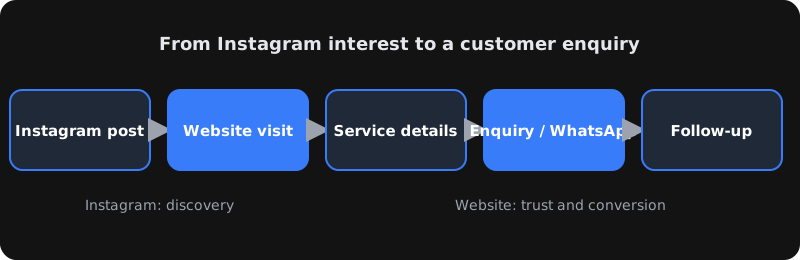
- Instagram post or Reel catches attention.
- Website visit from the link in your bio or a Story link.
- Service details — prices, photos, FAQs and reviews answer the customer's questions.
- Enquiry form or WhatsApp — one tap to contact you, with the enquiry recorded.
- Customer follow-up — you call back, send a quote, and later remarket to visitors with ads.
The website also feeds Instagram: you can show your Instagram feed or link to it, add the Meta Pixel to retarget website visitors with Instagram ads, and use website analytics to see which Instagram posts actually bring enquiries. Meanwhile your website and Google Business Profile capture the people who never saw your Instagram but searched on Google.
How to get started
- Identify your target customer — who they are, where they live and what they search for.
- Decide what the website must achieve — calls, WhatsApp enquiries, bookings or online sales.
- Prepare business information and images — logo, service list, prices, photos, address and timings.
- Choose an appropriate platform — WordPress, a custom build or a store platform. See WordPress vs custom website.
- Build the important pages — Home, About, Services or Products, Contact.
- Add contact and WhatsApp functionality — forms, a WhatsApp button and click-to-call on mobile.
- Configure basic SEO — page titles, descriptions, headings, sitemap and Search Console.
- Connect analytics — Google Analytics with enquiry tracking.
- Link Instagram and the website — website in your bio, Instagram on the website.
- Monitor enquiries and conversions — check monthly which channel brings real customers and keep the site updated, as covered in our website maintenance guide.
If you want the website to bring steady Google enquiries after launch, our SEO services cover local SEO and Google Business Profile optimisation.
Frequently asked questions
Is Instagram enough for a small business?
It can be enough at the start, especially for visual businesses with a local following. As the business grows, relying only on Instagram becomes risky because reach depends on the algorithm and Google searches mostly show websites and Google Business Profiles.
Do I need a website if I have Instagram?
If customers search for your products or services on Google, compare options before buying, or need detailed information like prices and timings, a website helps. Instagram and a website work best together: Instagram for discovery, the website for trust and enquiries.
Can a business website generate Google leads?
Yes. A website with clear service pages, basic SEO, a Google Business Profile and contact or WhatsApp buttons can appear in relevant Google searches and turn visitors into enquiries. Results build over time and depend on competition and content.
Is a website better than Instagram for selling products?
For repeat customers, full product catalogues and direct payments, a website or online store gives more control and keeps customer data with you. Instagram is better for showing products and creating interest. Many brands use Instagram to bring buyers to their store.
How much does a small business website cost in India?
At CodeServe, a starter website costs ₹9,999, a business website ₹19,999 and an e-commerce store ₹34,999, one-time. Domain and hosting are extra, usually about ₹4,000 to ₹12,000 per year together.
Can I connect Instagram to my website?
Yes. You can link your website in your Instagram bio and Stories, show your Instagram feed or profile link on the website, and add the Meta Pixel to the website to measure visits and retarget visitors with Instagram ads.
Should a new startup build a website immediately?
Start Instagram early to build an audience, and launch at least a simple website once you are ready to take enquiries, speak to investors or partners, or run ads. A small, clear website is better than waiting months for a large one.
About the author
CodeServe Team — the web development and automation team at CodeServe Community in KPHB, Kukatpally, Hyderabad. We build websites, AI chatbots, automation and business software, and write these guides from the questions clients ask us. Related service: learn how we can help.